Data model and file formats
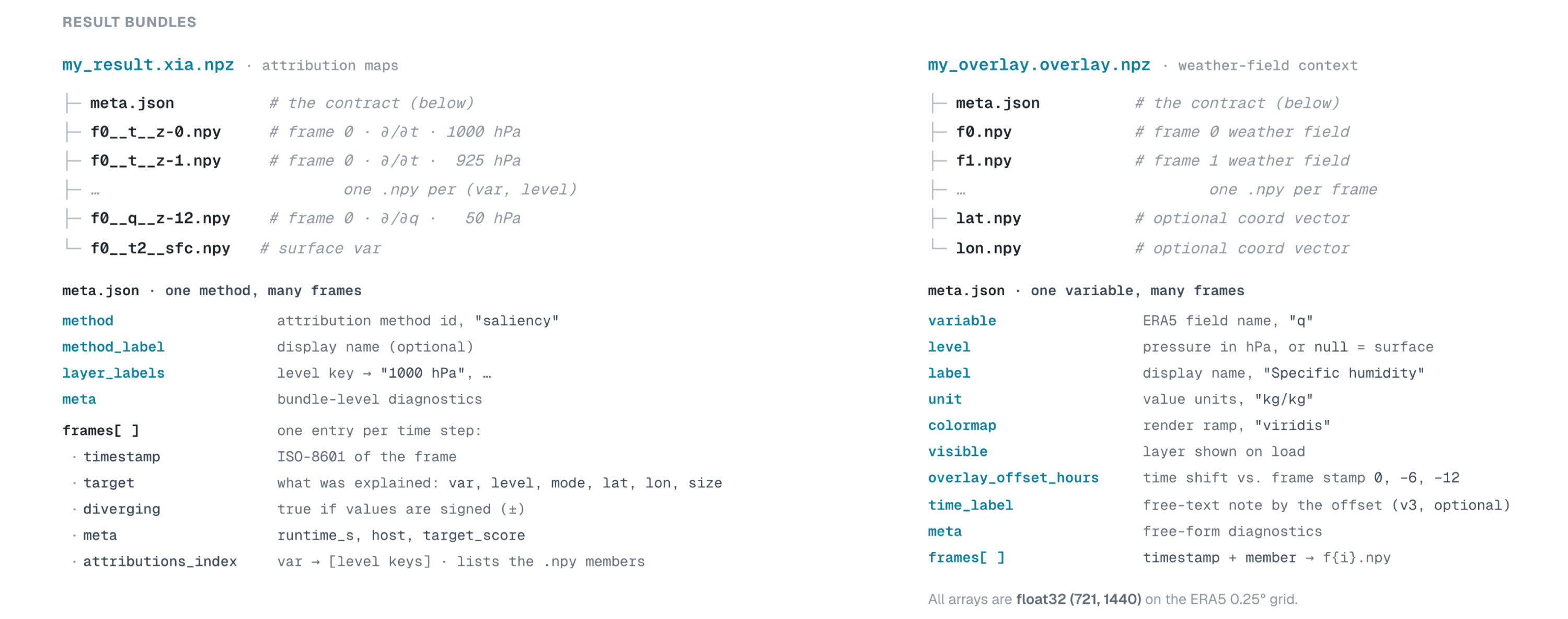
The two persisted formats side by side. An attribution bundle (.xia.npz, left) stores a meta.json manifest plus one .npy array per frame, input variable, and vertical layer. An overlay bundle (.overlay.npz, right) stores one weather field over time with display metadata and optional coordinate vectors. Both are zip archives; every array is float32 on the ERA5 (721, 1440) grid.
Attribution levels
Attributions are organized as:
Atmospheric level identifiers use "z-<integer>"; "sfc" is reserved for surface data. A higher integer renders at a higher vertical position. Backends may attach any human-readable labels to these IDs. For convenience, add_attribution(..., pressure_level=...) maps these common pressure levels to the built-in vertical order:
1000, 925, 850, 700, 600, 500, 400, 300, 250, 200, 150, 100, 50 hPa.
XiaResult
An attribution bundle contains:
method: the computation method label.frames: one or more timestampedXiaFrameobjects.layer_labels: display labels keyed by level identifier.meta: bundle-level diagnostics.
Each frame stores its target, timestamp, nested attribution mapping, diverging flag, and per-frame metadata. The viewer preprocesses arbitrary two-dimensional imported grids. A backend may therefore use its native regular-grid resolution; the Aurora backend, for example, produces (721, 1440) float32 fields.
Bundles store raw attribution magnitudes; normalizing them for display is a viewer-side choice. On import, each level is quantized against its own maximum absolute value and that value is kept alongside the grid, so the viewer can rescale the color range to any scope — per method, per frame, across all methods — on the fly. See Choose a normalization scope.
Compatible bundles can be saved as .xia.npz archives. The viewer loads them without importing the backend that produced them:
OverlayResult
An overlay bundle describes one weather variable and contains timestamped two-dimensional arrays plus its label, unit, colormap, and initial visibility. Compatible overlay files use the .overlay.npz suffix.
from geoxplain.overlay_result import load_overlay_result

overlay = load_overlay_result("humidity.overlay.npz")
Transport format
Saved bundles are zip-based NPZ containers with JSON metadata and one .npy member per grid.
Treat both persisted layouts as versioned interchange formats. Prefer the package save() and load() methods over reading archive members directly.
Transport is backend-specific. The Aurora backend, for example, serializes equivalent results with msgpack as application/octet-stream; its client converts the response back into an in-memory result before GeoXplain sees it.